
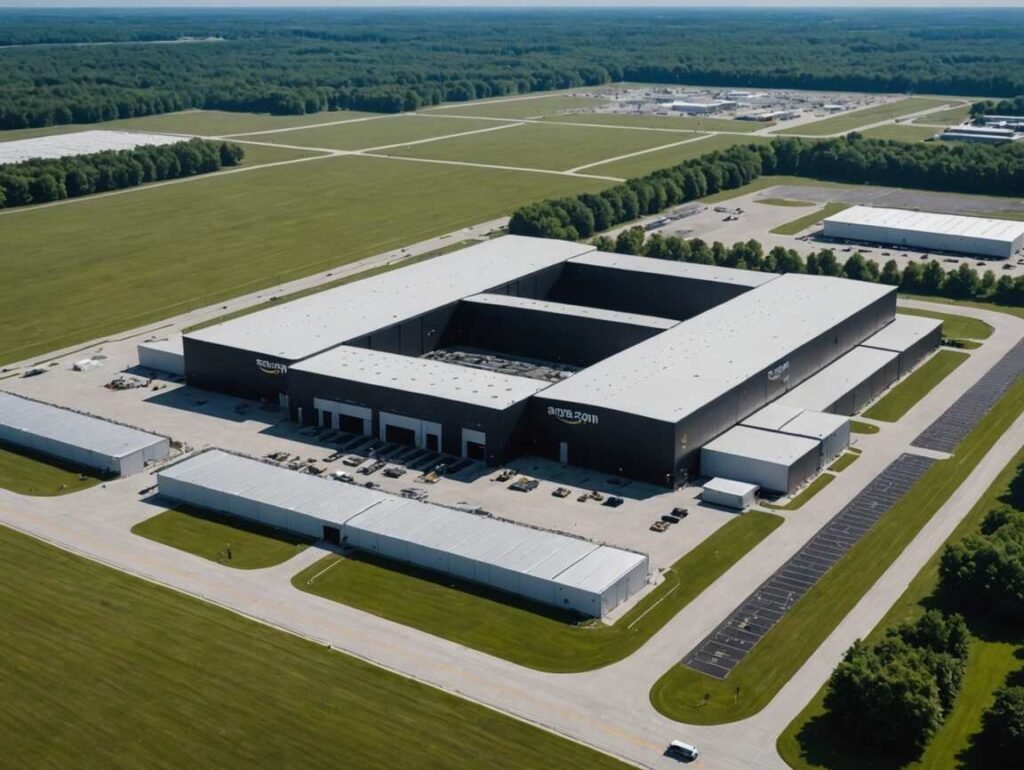

Project Rainier: A 1,200-Acre Supercomputing Cluster Powering Anthropic Claude AI Models in New Carlisle
Why Amazon Is Investing $11 Billion in Indiana? Why is one of the world’s largest AI power hubs being built in a small Midwestern town like New Carlisle, Indiana?
Amazon Web Services (AWS) has announced a massive $11 billion investment to construct a state-of-the-art artificial intelligence (AI) data center in Indiana — a move that underscores Amazon’s growing ambition to lead the next era of AI infrastructure.
Known as Project Rainier, the initiative spans 1,200 acres in St. Joseph County’s New Carlisle, where seven large-scale buildings are already under construction. The sprawling facility is designed to become one of the most powerful AI supercomputing clusters in the world.
So far, the site hosts over 500,000 of Amazon’s proprietary Trainium2 chips, with plans to scale that number to one million units by the end of 2025. The data center is primarily built to train and deploy Anthropic’s Claude AI models, marking a deepening partnership between Amazon and the fast-growing AI startup.
Amazon has already invested $8 billion in Anthropic, further integrating its cloud ecosystem with cutting-edge AI research and development.
Project Overview: Inside Amazon’s “Project Rainier” in Indiana
Located in New Carlisle, Indiana, Project Rainier is Amazon Web Services’ (AWS) newest and most ambitious AI infrastructure project to date. Officially launched this week, the massive data center complex spans over 1,200 acres and currently includes seven operational buildings, with expansion plans for up to 30 facilities in the coming years.
Meanwhile, in the AI race, Mark Zuckerberg’s $29B Meta AI bet has faced significant challenges, highlighting the high stakes in large-scale AI investments.
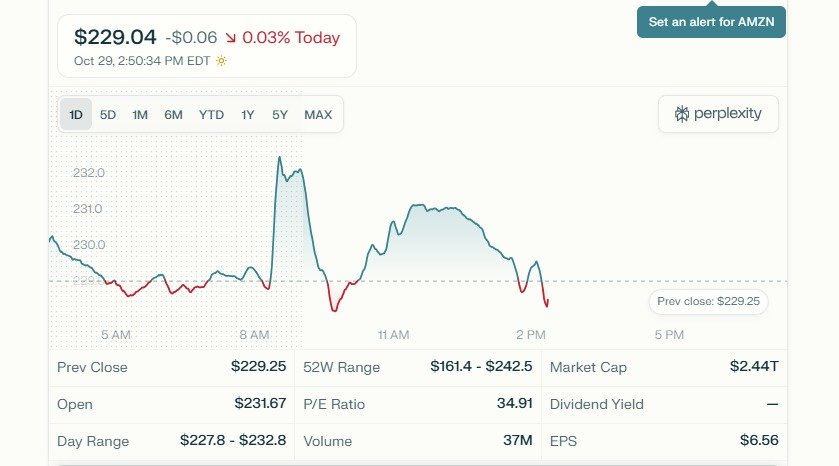
At the heart of this facility lies Amazon’s custom-built Trainium2 chips, purpose-designed for large-scale AI training workloads. The Trainium2 processors deliver 30–40% better price-performance efficiency compared to standard GPUs such as those from Nvidia, allowing Amazon to train massive AI models faster and more cost-effectively.
So far, more than 500,000 Trainium2 chips have been installed, and that number is projected to exceed one million by the end of 2025.
What makes Project Rainier truly unique is its AI “supercluster” architecture — an intricate web of interconnected ultra-servers and high-speed networking nodes that enable synchronized, large-scale model training.
Partner company Anthropic, in which Amazon has invested $8 billion, is already using the facility to train its next-generation Claude AI models. This partnership highlights Amazon’s long-term strategy to position AWS as a global powerhouse for enterprise AI training and deployment.
Amazon’s Strategic Motives Behind Project Rainier
At the core of Amazon’s $11 billion Project Rainier lies a clear strategic objective — reducing dependence on Nvidia and scaling its in-house AI training capabilities. Through its Trainium2 chips, Amazon aims to power AI model training using its own hardware infrastructure rather than relying on third-party GPUs.
Industry research indicates that Trainium2 can deliver comparable AI model performance at nearly half the cost of Nvidia’s flagship chips. This cost efficiency effectively reduces what analysts often call the “Nvidia tax”, giving AWS customers a more affordable yet powerful alternative for large-scale AI workloads.
Beyond hardware independence, Project Rainier is designed to strengthen Amazon’s global AI position amid a rapidly intensifying tech race. By partnering with Anthropic, one of the fastest-growing AI startups, Amazon ensures that popular models like Claude and future generations of large language models will be trained and deployed directly on AWS infrastructure.
Since AWS remains Amazon’s most profitable business segment, surpassing its retail and logistics arms in margins, investments in high-performance AI infrastructure like Project Rainier are central to Amazon’s strategy for cost optimization and long-term revenue growth.
Challenges and Criticisms
However, the construction of such a massive data center project has also sparked concerns and criticism from local communities and environmental groups.
One of the primary issues is the enormous consumption of electricity and water. Local residents and activists argue that “data centers consume millions of gallons of water and vast amounts of power,” potentially straining regional utilities and groundwater sources. Reports from local Indiana news outlets indicate that electricity bills in some nearby areas have surged by nearly 267% over the past few years. With Project Rainier expected to draw up to 2.2 gigawatts of power, energy demand in the region is projected to rise sharply.
Environmental concerns are equally pressing. The facility’s construction requires converting thousands of acres of farmland into industrial land, threatening agricultural livelihoods and altering the local landscape. Moreover, the massive cooling systems necessary for AI data centers require constant groundwater extraction — which could deplete local wells and aquifers over time.
Community leaders have voiced worries that rural towns like New Carlisle might bear the environmental and economic costs of global tech expansion. Critics also point out that, despite the project’s scale, long-term employment opportunities remain limited, while tax incentives granted to Amazon may reduce local revenue. Activist groups have called for greater transparency from state authorities about who will ultimately bear the infrastructure costs for the increased power and water demands tied to the project.
Future Plans and Technological Outlook
Following the launch of Project Rainier, Amazon has already announced plans for several additional AI data centers. According to the company’s long-term roadmap, seven new facilities are being developed in and around New Carlisle, with over 30 more data centers planned for future expansion.
Beyond Indiana, Amazon is reportedly exploring similar large-scale compute clusters in Mississippi, North Carolina, and Pennsylvania, gradually building what executives describe as a massive “ultracluster” — a globally distributed network of interconnected AI supercomputing hubs powered by Trainium chips.
From a technological perspective, major innovations are on the horizon. Amazon is actively developing Trainium3, the successor to Trainium2, which is projected to deliver up to four times greater processing power while reducing energy consumption by nearly 60%. Future phases of Project Rainier may integrate these new chips into lighter, more efficient AI servers, capable of training even larger language models at a fraction of current costs.
Additionally, Amazon plans to connect all its AI facilities through its high-speed Elastic Fabric Adapter (EFA) networking technology — designed to offer lower latency and higher throughput compared to traditional interconnect systems. This would enable seamless collaboration between data centers, optimizing both AI research and enterprise-level cloud applications.
Ultimately, Amazon’s long-term vision with Project Rainier is to establish global dominance in AI infrastructure. By deepening its collaboration with Anthropic, Amazon aims to integrate next-generation intelligence across its ecosystem — from Alexa to AWS Cloud AI services. Even if Anthropic’s models don’t scale as expected, the company’s massive compute infrastructure can easily be repurposed across AWS workloads, ensuring strategic flexibility and future-proofing for Amazon’s AI ambitions.
In essence, Project Rainier represents a cornerstone investment in the future of AI-driven cloud computing — a bold bet that positions Amazon at the center of the world’s emerging AI supercluster network.
- Sources: The information presented in this report has been compiled from a range of official and industry sources, including Amazon Web Services’ official blog, TipRanks, GuruFocus, and DeepLearning.ai, which cover Amazon’s AI and data center developments.
- Local perspectives and public reactions regarding the data center construction were gathered from Indiana-based news outlets WSBT and WFYI.
All statistics, technical details, and cited statements have been verified and attributed to their respective sources for accuracy and reliability.
FAQs: Amazon’s $11 Billion AI Data Center in Indiana
1. Why is Amazon investing $11 billion in an AI data center?
Amazon is expanding its AI and cloud capabilities through AWS. The $11 billion investment will enhance computing power, storage, and scalability for next-gen AI applications and enterprise cloud services.
2. Why did Amazon choose Indiana for the new AI data center?
Indiana offers low energy costs, a strong infrastructure, and access to renewable power sources — making it ideal for large-scale data centers. The state’s business-friendly policies also attract long-term tech investments.
3. How will this new data center impact Amazon Web Services (AWS)?
The Indiana AI data center will strengthen AWS’s global cloud network, reduce latency in the U.S. Midwest, and increase AI model training efficiency, boosting Amazon’s competitive edge in cloud computing.
4. What are the economic benefits of Amazon’s investment in Indiana?
The project is expected to create thousands of jobs, support local contractors, and boost Indiana’s tech-driven economy through infrastructure upgrades and renewable energy initiatives.
8. Will Amazon’s new AI data center be eco-friendly?
Yes. Amazon plans to use renewable energy sources to power the Indiana facility, aligning with its commitment to achieve net-zero carbon emissions by 2040.
6. When will the Indiana AI data center become operational?
Construction is expected to start in 2025, with operations rolling out in phases over the following years as part of Amazon’s long-term AI infrastructure expansion plan.